One Tree, Two Powers: Rethinking Eden Through Hebrew Eyes
Most of us grew up with the picture of Eden having two trees:
the Tree of Life and the Tree of the Knowledge of Good and Evil.
Two trees. Two fruits. Two choices.
But when you slow down and actually read the Hebrew — especially the moment right after Adam and Eve eat — the text doesn’t force that picture. In fact, it allows something much simpler and, honestly, much more elegant.
It may not be two trees at all.
It may be one tree with two powers.
Let me walk you through it the way I see it.
The Hebrew Word That Changes Everything: גַּם (gam)**
Right after Adam and Eve eat, God says:
“The man has become like one of us, knowing good and evil.
Now, lest he reach out his hand and take also (גַּם gam) from the tree of life…”
That little word “also” is doing a lot of work.
Most English readers assume “also” means:
“also from the second tree.”
But the Hebrew word gam doesn’t require a second tree.
It often means:
“another part of the same thing”
“more of what he already took”
“further”
In other words, the text can be read like this:
“He already took one thing from the tree.
Now he might take something else from it also.”
That’s a very different picture.
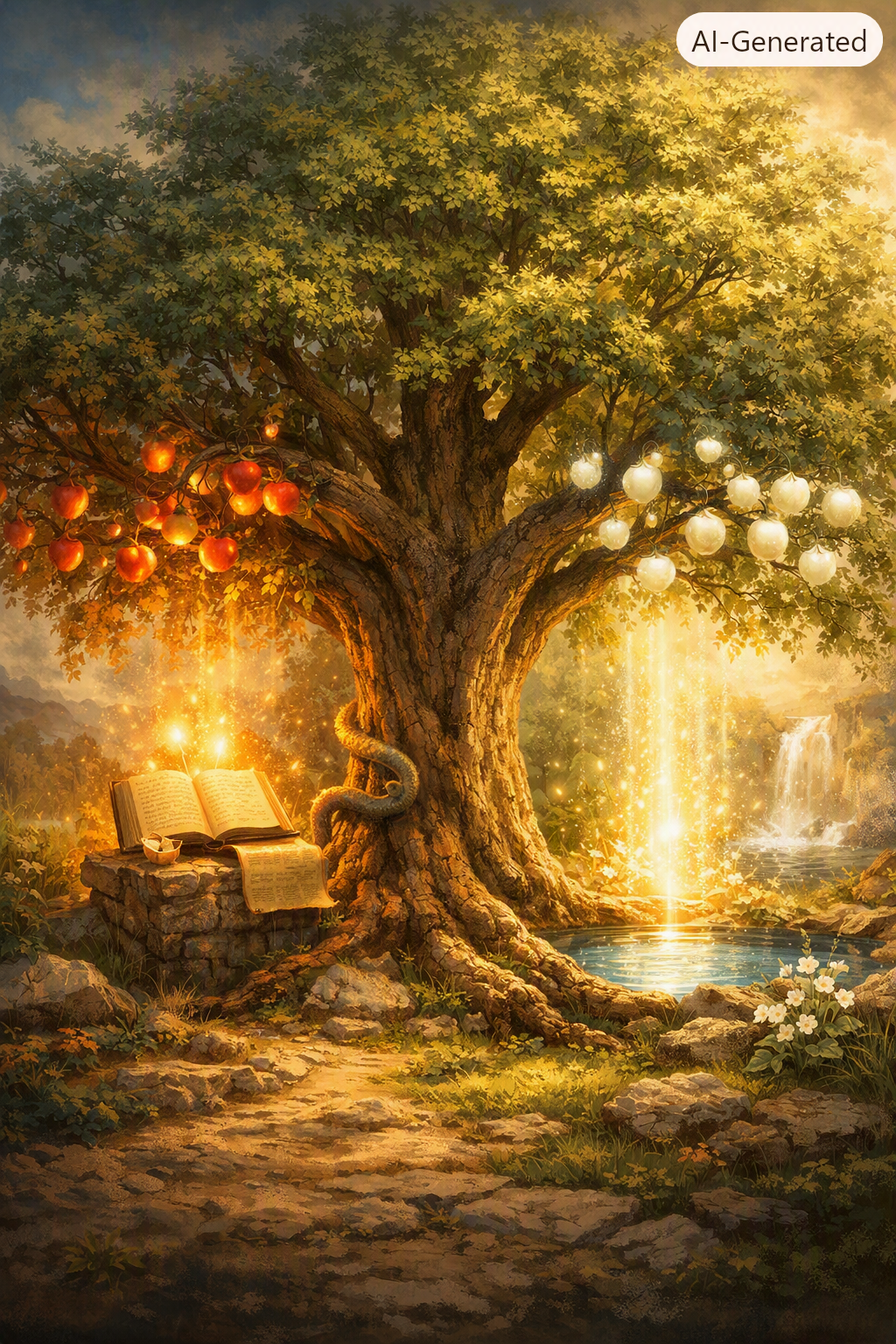
One Tree With Two Powers
If you follow the Hebrew, the tree in the center of the garden may have had two divine powers built into it:
1. דַּעַת (da’at) — Knowledge**
The ability to define good and evil.
Moral autonomy.
Self‑determination.
2. חַיִּים (chayyim) — Life**
Immortality.
Endless existence.
Eternal being.
Adam and Eve reached for the knowledge‑power.
God steps in because He sees the danger:
they might reach for the life‑power also.
Not two trees.
One tree with two dimensions.
Why God Blocks the Tree
If humanity takes both powers — knowledge and life — the result is catastrophic.
Think about it:
eternal autonomy
eternal rebellion
eternal self‑definition
eternal brokenness
Immortality + corruption = permanent ruin.
So God blocks access to the second power — not out of anger, but out of mercy.
He’s protecting humanity from becoming eternally broken beings.
This changes the tone of the whole story.
God isn’t punishing.
He’s preventing disaster.
The Tree as a Divine Interface
In this reading, the tree becomes a kind of interface between humanity and God:
Power 1: Knowledge
Humanity grabbed this prematurely.
Power 2: Life
God protects humanity from grabbing this prematurely.
The issue isn’t fruit.
It’s divine prerogatives.
Humanity reached for one divine power.
God blocks the second.
The Ending of the Story Makes Sense Again
In Revelation, the Tree of Life shows up again.
But the “Tree of Knowledge” never does.
Why?
Because humanity already took the knowledge‑power.
Redemption restores access to the life‑power.
The story begins with humanity misusing divine power.
It ends with humanity finally ready for divine life.