When the ancients spoke - Part one
MO
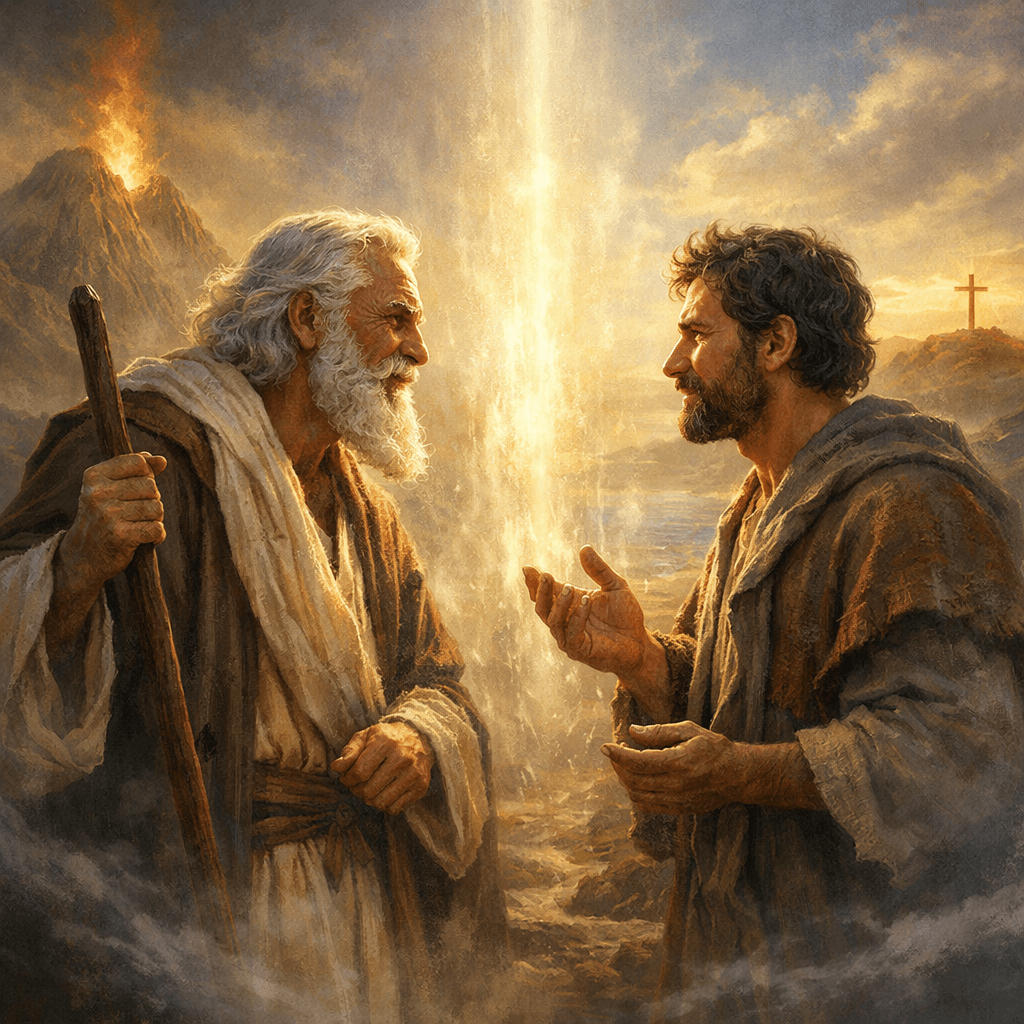
When the Ancients Spoke
Episode 1 — Moses & Peter: The Man Who Ran Meets the Man Who Sank
The place had no name.
It didn’t need one.
It was the kind of place only God could make — where time didn’t run in straight lines, where the old and the new could stand side by side without contradiction, where the stories of God’s people converged like rivers meeting the sea.
Peter arrived first.
He wasn’t sure how. One moment he had been praying, the next he was standing on ground that felt familiar and foreign all at once. The air carried the scent of wilderness — dry earth, distant water, and something ancient.
He turned slowly.
A figure approached from the far side of the clearing, walking with the steady, deliberate steps of a man who had learned patience the hard way.
The staff gave him away before the face did.
Peter’s breath caught. “Moses…?”
The older man smiled, lines deepening around eyes that had seen plagues, seas part, nations rise, and his own temper fall. “And you must be Simon,” Moses said, “the one they call Peter.”
Peter swallowed. “I… I don’t know what I’m doing here.”
Moses chuckled softly. “Few of us ever do when God calls us somewhere unexpected.”
They stood facing each other — the shepherd who ran from Egypt and the fisherman who sank beneath the waves.
Two men shaped by failure. Two men restored by God. Two men who knew what it meant to be called anyway.
The Conversation
Moses leaned on his staff. “I’ve heard your story.”
Peter winced. “Which part?”
“The part where you stepped out of the boat,” Moses said. “And the part where you sank.”
Peter looked down. “I thought I had faith. I thought I was ready.”
Moses nodded slowly. “I thought the same when I struck the Egyptian.”
Peter’s head snapped up. Moses’ eyes were gentle, not accusing.
“I ran,” Moses said. “I ran from my calling, from my people, from myself. I spent forty years hiding in the desert.”
Peter exhaled. “I denied Him. Three times. After everything He’d done for me.”
Moses stepped closer. “And yet… He called you again.”
Peter’s voice cracked. “Why? Why would He trust me after that?”
Moses smiled — the kind of smile that comes from knowing God longer than your own excuses. “Because He knows what’s in you. Even when you don’t.”
Peter shook his head. “But I failed Him.”
“So did I,” Moses said. “So did Abraham. So did David. So did every man God ever used.”
Peter looked up, eyes wet. “But you… you led a nation.”
Moses’ voice softened. “Only after I learned that God doesn’t choose the strong. He strengthens the chosen.”
Peter let the words settle. They felt like water on dry ground.
The Turning Point
Moses lifted his staff and drew a line in the dust between them.
“Simon,” he said, “do you know what this is?”
Peter frowned. “A line?”
“A moment,” Moses corrected. “A dividing line. Before this moment, you were the man who sank. After this moment, you become the man who stands.”
Peter stared at the line.
Moses continued, “You think your failure disqualifies you. But God uses failure as the doorway to calling.”
Peter whispered, “I’m afraid.”
“So was I,” Moses said. “But fear is not the enemy. Running is.”
Peter looked up sharply.
Moses held his gaze. “You sank because you looked at the wind. I ran because I looked at myself. But God… God looks at neither. He looks at the heart He is shaping.”
Peter stepped over the line.
Moses nodded. “Good. Now you walk forward.”
The Blessing
Moses placed a hand on Peter’s shoulder — the same hand that once held the tablets of the covenant.
“Peter… the God who met me in the burning bush is the same God who met you on the water. The God who parted the sea is the same God who pulled you from the waves. The God who restored me after my anger is the same God who restored you after your denial.”
Peter felt something settle inside him — not pride, not confidence, but peace.
Moses stepped back. “Go. Lead. Feed His sheep. And when the road feels too heavy… remember this.”
Peter waited.
Moses smiled. “You are not the man who sank. You are the man He saved.”
And just like that, the clearing faded.
Peter found himself back where he had been — but different. Steadier. Rooted. Called.
Not because he was perfect.
But because God was.